
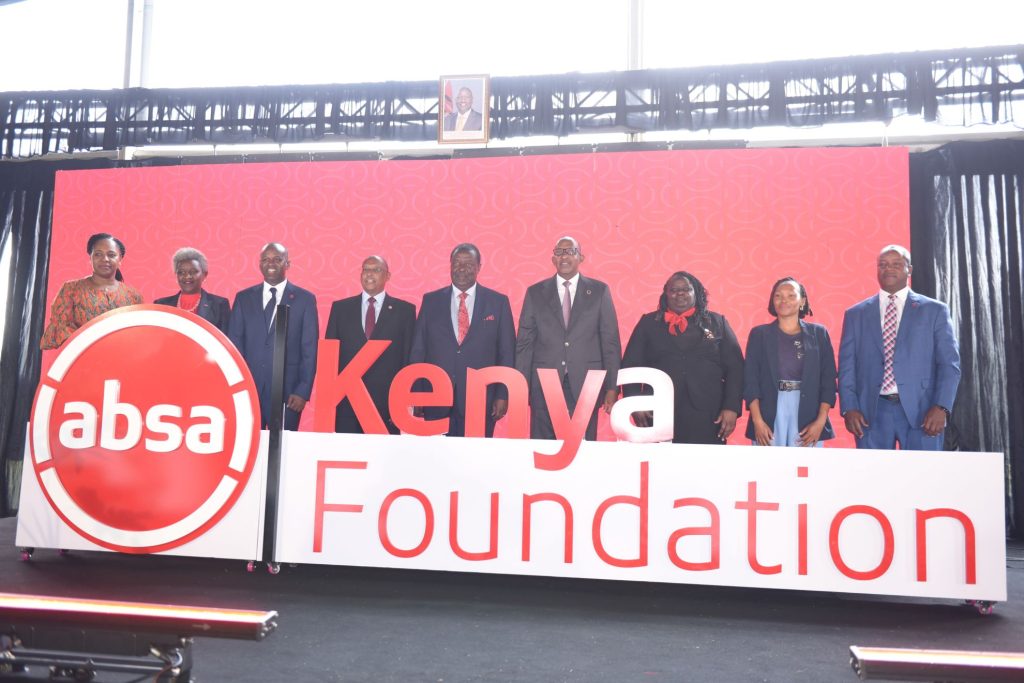
In today’s business landscape, success is no longer measured solely by profits, but by purpose. Increasingly, institutions are being called upon to demonstrate how they uplift communities, unlock opportunity, and create lasting social value. Few have embraced this mandate as deliberately as Absa Bank Kenya.
According to its 2024 Sustainability and Climate Report, Absa is redefining what inclusive growth looks like placing women and youth at the centre of its strategy. These two groups are not only Kenya’s demographic majority; they are its economic future.
Through the Absa Kenya Foundation, the bank reaffirms its purpose of “Empowering Africa’s tomorrow, together… one story at a time,” ensuring that economic progress goes hand in hand with social well-being and environmental stewardship. ” Absa has woven inclusion into its business model, proving that when women and young people thrive, businesses and economies grow stronger.
With over 75% of Kenya’s population under the age of 35, youth inclusion is no longer optional—it is urgent. Absa’s approach recognises that access to finance must go hand-in-hand with access to skills.
Through its flagship ReadytoWork programme, Absa equips young people with essential workplace, financial, and entrepreneurial skills—at no cost. By the end of 2024, over 263,000 youth had benefited from the programme, with more than 11,000 trained in the past year alone. The bank’s long-term ambition is bold: to empower one million young people by 2030, ensuring they are ready to lead in a digital, innovation-driven economy.
Understanding that young entrepreneurs often lack traditional collateral, Absa leveraged its Timiza digital platform to unlock instant, accessible credit. In 2024 alone, KSh 25.1 billion was disbursed through Timiza, primarily supporting youth-led startups and informal enterprises. An additional KSh 5.8 billion was extended to entrepreneurs aged 18–35, translating ideas into income and resilience
For women entrepreneurs, access to capital is only part of the equation. Networks, markets, confidence, and visibility matter just as much. Absa’s Women in Business (WIB) proposition responds holistically to these realities.
Through initiatives such as SHE (See Her Empowered) and the Tuungane 2X Incubator, Absa supported 26,281 women entrepreneurs in 2024 with training, mentorship, and market-ready skills. The bank also disbursed KSh 1.1 billion in targeted financing to women-led businesses capital designed to grow, not constrain, ambition.
Beyond lending, Absa is challenging structural barriers through its Sourcing2Equal programme. In partnership with IFC, the bank has trained over 1,500 women-owned businesses to compete for large corporate tenders. More importantly, Absa is walking the talk; committing to 20% supplier diversity by intentionally directing procurement spend to women-owned enterprises.
This shift signals a powerful truth: women are not just beneficiaries of the economy; they are suppliers, partners, and industry leaders.
Absa’s external advocacy for women is reflected internally. In an industry where leadership imbalance remains the norm, the bank has achieved near parity across its workforce.
51:49 female-to-male employee ratio
40% women on the Board


41% women in senior management
50% women in management targeted by 2025
This commitment sends a clear message: women belong at decision-making tables—and perform exceptionally when they get there.
In 2024, Absa allocated KSh 43 billion towards financial inclusion for SMEs, women, youth, and persons with disabilities. This is not just capital deployment; it is nation-building.
As the bank advances toward its Net-Zero ambitions and deeper digital transformation, inclusion remains its compass. By placing women and youth at the heart of its strategy, Absa is ensuring that growth is shared, sustainable, and rooted in purpose.
Because when women rise, businesses expand. When youth succeed, economies accelerate. And when finance is inclusive, prosperity becomes possible for all.